The Seventeenth Human Species Gives Way to the Eighteenth
The Old AxolotlThe Seventeenth Human Species Gives Way to the Eighteenth is the terminal succession in humanity’s long post-Extermination history: after several hundred thousand years, the Seventeenth species gives way to the Eighteenth, which proves to be the last. The event is set against a future so distant that civilizations, environments, and even the memory of humanity pass into cycles beyond human measure.
A World in Repeated Transformation
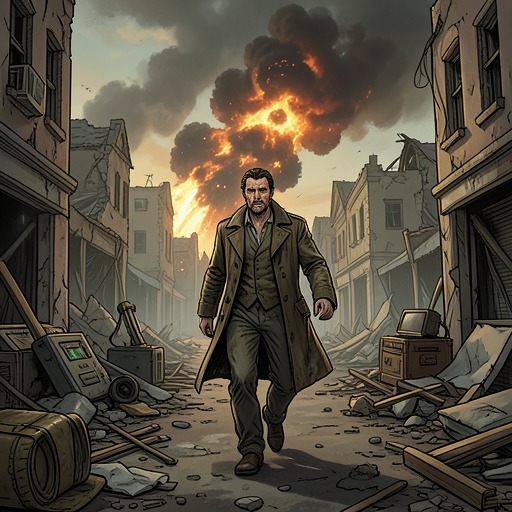
The transition follows an immense procession of change. Radiant metropolises succumb to volcanic eruptions, meteor strikes, lightning, fires, and floods; later, deserts bloom with unfamiliar floras and Mothernet forms, while metallic grasses and migrating flowers remake the landscape. Other periods bring swarms of sprites, processions of kami and gods, and wooden airships drifting among low clouds. These visions do not settle into a single story of progress: flourishing gives way again to desert, fallow land, and dead mirages, before self-animated matter reshapes the world once more.
The transformations extend beyond living forms. Stones speak to dunes, sand gathers into towers and termite mounds, and poetic biomechs appear amid landscapes described as Life without life. The variety of these successive worlds makes the eventual human transition part of a far larger pattern of emergence and disappearance, rather than the culmination of a stable civilization.
The Succession
The narrative measures the passage of time in enormous leaps: 200,000 and 300,000 days after the Extermination, then a million, followed by five and ten million. Against that scale, the Seventeenth species’ few-hundred-thousand-year career is both crowded with splendor and agony and temporary. Its successor is not presented as the restoration of an earlier humanity; it is another species in a history of successive forms.
The decisive fact emerges retrospectively: the Eighteenth is not simply the next human species but the last. The spare announcement gives the succession its force. A change that might otherwise read as one more turn in an open-ended sequence becomes the final human passage, though the surrounding history continues far beyond it.
After Humanity
By the time the chronology reaches five or ten million days after the Extermination, the narration considers it likely that no one remembers either the catastrophe or humanity. Memory itself has become subject to material limits: there is no power or resources left to sustain it. The result is not a preserved human legacy but a universe in which the distinction between remembered and forgotten history has lost its practical force.
The count then leaps to 100, 200, and 300 million. The joyful clock of the void continues while galaxies and universes rise and set in the cracked lenses of a rusted mech. This image places the species’ succession within an immense, indifferent duration: even the last human species does not mark the end of change. What remains in the final vista is hardware and cosmic motion, while the human past has receded beyond remembrance.